Start the virtual machine that you created and follow these steps:
Choose the installation option shown in the following screen capture:
Tiny Core Linux installing the file manager Midnight. Windows Mac Genius 83,779. Installing Tiny Core Linux from the command line. Tiny Core: Installation. This How-to is based on my experience with Tiny Core 4.6.2. Initial Install (Windows). Frugal Install Tiny Core Linux. The first step before you install any operating system such as Tiny. Tiny Core Linux 8.0, released last week, is a minimalist Linux OS built from scratch with a focus on being as small as possible. That means you should be able to run this Linux distro on a wide range of legacy machines. The tradeoff for ultra smallness, however, often is a not-so-powerful OS that can leave you longing for better options. The Core Project is based on a highly modular system.
Run the Tiny Core installer by clicking TC_Install:
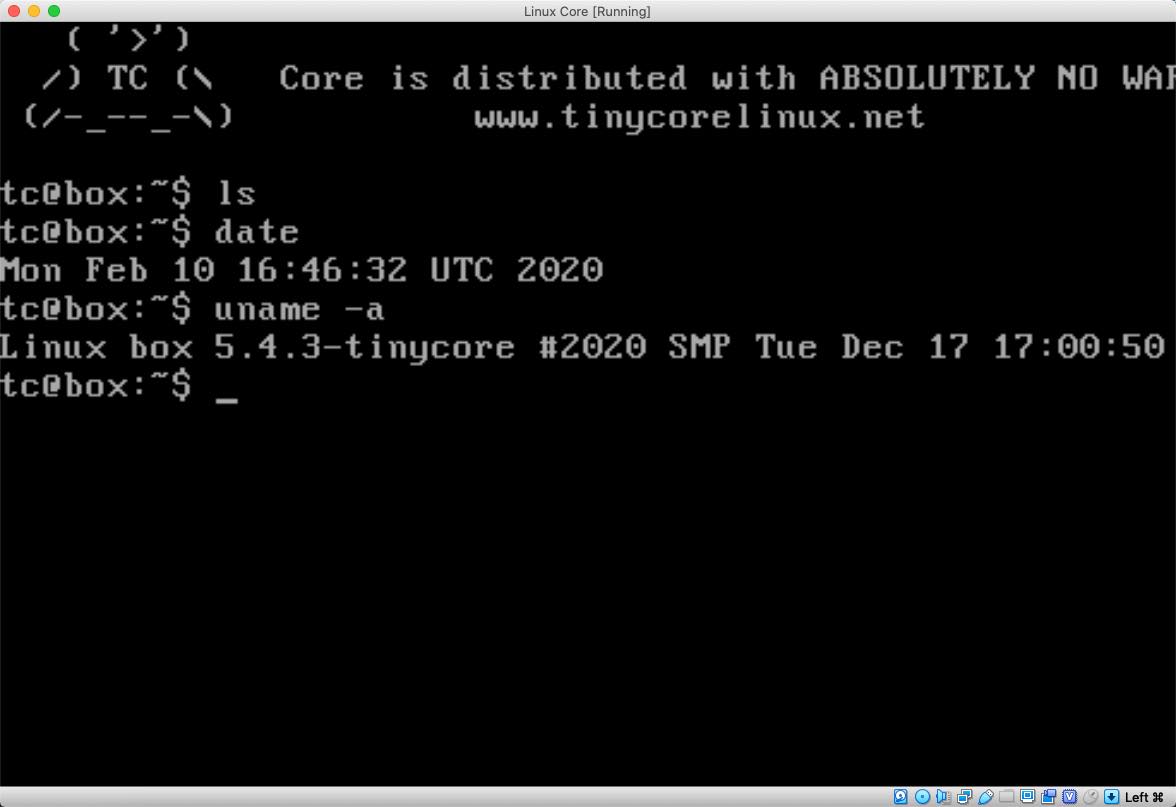
Tiny Core (Core) Linux doesn’t come with any default SSH Server, which means you can’t do ssh login if you wish to configure this incredibly sim operating system remotely. If you wish to run Tiny Core on a headless machine and want to configure it remotely over ssh login session, follow this article to configure SSH Server on Tiny Core –. Installing Tiny Core Linux on a Wyse thin client. Posted at 2016-05-26. I decided to try Tiny Core Linux on one of the Wyse thin clients I have and picked the middle ground with a Cx0. Install Tiny Core. I downloaded CorePlus-7.1 ISO and put it on the same spare USB key I used to install Debian on the Igel. Download the ISO file from the Tiny Core download page (download the TinyCore version).; Burn the ISO to a CD (or put it on a USB drive). Put the CD (or USB drive) into your machine and boot up.
Start the Tiny Core installation and follow these panels to install it on an empty harddrive:
Leave the pre-filled path as core.gz (default path).
Select the check box Whole Disk and select sda asthe core disk.
Any user files and extensions are stored outside the base operatingsystem.
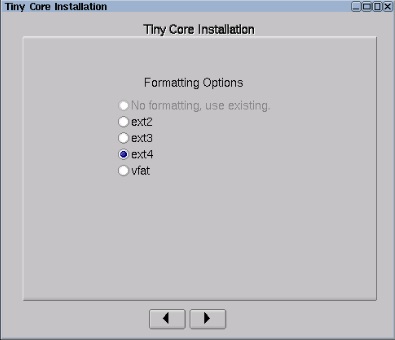
Format the new partition. It is recommended that you select the ext4 option to support theLinux permissions.
If you want to use additional boot codes, such as screen resolution or keyboard mapping, enterthem now.
Set the location of the persistent home directory home=sda1.
Set the location of the persistent opt directory opt=sda1.
Select the Core Only (Text Based Interface) option to havea virtual machine with only the CLI.
If everything is OK, click Proceed.
The time required varies depending on the size of your hard drive.
Tiny Core Linux is now installed.
Restart the machine by clicking Exit, selecting Reboot, and clickingOK.
By choosing to reboot, you ensure the data persistence. Do notuse Shutdown at this stage.
TinyCoreLinux is handy for various tasks. I use the dCore variant because it can use many of the packages from Debian.
Qemu is especially useful because it is portable (can run off a USB flash drive) and there are versions for multiple host OS's (eg. Windows, Linux). The downside is that it's a bit slow under Windows - it needs a suitable driver to use hardware virtualisation, and there doesn't seem to be one for Windows hosts - still, it is fast enough to be useful.
This document was tested with the 25-May-2016 (v7.0?) release of dCore TinyCoreLinux, running under Qemu v2.5.0 on Windows 7 (64-bit).
Download TinyCoreLinux
Create a new directory for your VM - for this document I have used C:dCore
As at time of writing, the download directory for dCore Jessie is http://tinycorelinux.net/dCore/x86/release/dCore-jessie
If that directory does not work, start at http://tinycorelinux.net, click 'Downloads' (at top of page), then 'Other Ports (x86-64, dCore, & Raspberry Pi)', then 'Releases' in the 'dCore x86' section, then 'dCore-jessie'
Download these files and put them in C:dCore:

Note that windows will probably rename the kernel from vmlinuz-jessie to vmlinuz-jessie.txt - you should rename it back to vmlinuz-jessie after download. If you've got file extensions turned off in Windows Explorer, then this will be inconvenient, and it's probably less effort to edit the launcher script to include the .txt even though the kernel is not a text file.
If you're being thorough, download the 'md5' files and use them to check the integrity of the files.
Download Qemu
I use the build of qemu found at http://lassauge.free.fr/qemu
Download Qemu-2.5.0-windows.7z and extract it into C:dCore - this will create a directory C:dCoreQemu-windows-2.5.0 containing the various qemu exe files and DLLs, etc.
Create empty disk image
We need to create a virtual hard drive to store persistent files in. Open a command prompt in C:dCore and run the following qemu-img command (you may want to specify a size different than 4G, depending on requirements):
Close the command prompt window.
Create launcher script
Micro Core Linux
Create a batch file 'C:dCorego.cmd' and edit it to contain (or download):
Note: There can be no spaces at the end of the lines after ^
Things you might want/need to edit:
Install Tiny Core Linux From Windows
QEMUDIR- if you're using a different version of qemu, or have saved it somewhere else.QEMUEXE- if you're not using 64-bit windows then you probably needqemu-system-i386.exe- the name of the
kernel/initrdif you've got a newer release of dCore than Jessie, or they have different names (like an unwanted.txtextension). - change the
-kline to change the keyboard layout - you can see the valid options inC:dCoreQemu-windows-2.5.0Bioskeymaps - change the
-mline to change the amount of memory allocated to the VM. - change the window title with the
-nameline. - change the
-redirline to alter port-forwarding - the line shown above redirects port 22022 on the host machine (your Windows computer) to port 22 inside the VM. This is no use right now, but will be useful if you install SSH inside the VM. - in the
-appendline you can setup kernel command-line options.host=dcoresets the hostname of the VM.xvesa=800x600x24sets the VM display resolution.
Check
Just as a cross-check of the above instructions, this is what my directory contains:
First boot, and format virtual HDD
Double-click on go.cmd and wait for it to boot (takes about 30s on my machine). Note that the boot process is a little 'messy' - you may have some messages appearing over the top of console. There are also error messages regarding the floppy drive (fd0), since it doesn't exist.
Wait for it to stop printing things, then press [Enter] a few times to get a clean prompt.
On a normal system, we'd partition the HDD and install a bootloader - this is not necessary here because we have our kernel/initrd supplied externally to the VM. We create a filesystem directly on /dev/sda instead of the more usual /dev/sda1

Install Tiny Core Linux From Windows 10

Run the following (ignore the harmless partition table warning):
Reboot and test
Click in the qemu window and run the following:
The VM will now reboot. Wait for it to start up and then have a look at the sda mountpoint:
Install Tiny Core Linux From Windows Xp
You should see that TinyCoreLinux has created the home, opt, and tce directories. If you create some SCE files (with sce-import), for example, they will be stored in /mnt/sda/tce/sce/
Similarly, your home folder files (for the default user 'tc') will be stored in /mnt/sda/home/tc/
References
- Qemu comes with a help file - refer to
C:dCoreQemu-windows-2.5.0Docqemu-doc.htmlor find online qemu docs at http://wiki.qemu.org/Manual